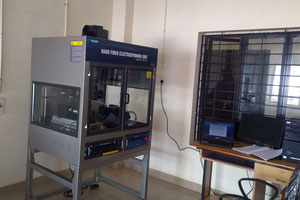

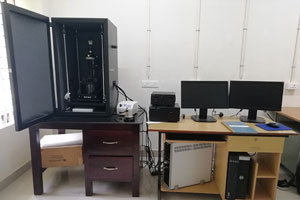

The centre supports research activities of the associate faculty and their research personal by providing facilities such as:
- Wet Synthesis laboratory with work benches, rotary evaporator, adequate fume hood, Glove boxes, vacuum lines, Air, N2 gas lines etc.
- Instrumentation facility such as diffuse reflectance spectrometer, spin/dip coating facilities, Electrospinning facility and glove boxes. The facility is supported by a 10KVA uninterrupted power supply system for backup power.
- IUCND is equipped with advanced research facilities, including an Atomic Force Microscope (AFM) for high-resolution imaging, an electrochemical workstation, a Triboelectric setup with an electrometer for energy harvesting and sensing studies, and a thermal evaporator for thin-film deposition.
Atomic Force Microscope

Make and Model: Keysight 5500 scanning Probe Microscope
Funding Agency: Govt. of Kerala
The Keysight 5500 Scanning Probe Microscope (SPM) is a versatile, high-performance system designed for nanoscale imaging and surface analysis across a wide range of research fields including materials science, nanotechnology, polymers, and life sciences. It supports multiple imaging modes such as Atomic Force Microscopy (AFM), Scanning Tunneling Microscopy (STM). With its modular design, top-down scanning capability, and interchangeable scanners, it allows for both high-resolution and large-area imaging. The system offers advanced features like environmental and temperature control, sealed chambers for humidity or gas regulation, and integration with inverted optical microscopes for enhanced sample navigation. Powered by PicoView software, the 5500 SPM enables real-time, multi-channel imaging and precise force measurements, making it a powerful tool for detailed surface characterization and nanoscale research.
Solar Simulator
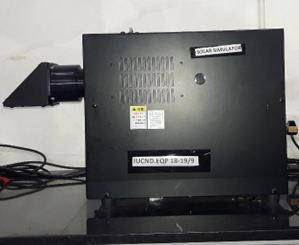
Make and Model: SAN-EI- Electric, XES- 50S1- RY 014
Funding Agency: Govt. of Kerala
The SAN-EI Electric XES-50S1-RY 014 solar simulator is a compact, high-performance Class AAA light source designed for precise solar energy research and testing. It uses an AM 1.5G filter and provides stable irradiance of 1000 W/m² (1 Sun), ideal for photovoltaic and photoelectrochemical applications. The system ensures excellent irradiance uniformity and temporal stability, making it suitable for accurate and repeatable measurements. A key feature of this simulator is its rotatable lens unit, which can be freely rotated and fixed at every 90°, allowing flexible adjustment of the light direction. Its reliable output and versatile design make it a valuable tool for laboratory-scale solar characterization.
External Quantum Efficiency (EQE) [CAM]
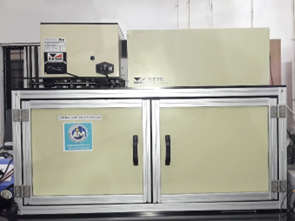
Make and Model: BENTHAM, PVE300
Funding Agency: Govt. of Kerala
The BENTHAM PVE300 is a high-precision External Quantum Efficiency (EQE) measurement system designed for detailed characterization of photovoltaic devices. It features the TMc300 monochromatic probe equipped with a triple-grating, symmetric, single Czerny-Turner monochromator with a 300 mm focal length, ensuring high spectral resolution and accuracy. The system uses both a 75 W Xenon lamp and a 100 W Quartz Tungsten Halogen (QTH) light source to cover a wide spectral range. It operates across 300–1100 nm using a 1200 g/mm grating and 1100–2500 nm with a 600 g/mm grating, enabling complete analysis of solar cell response over the UV, visible, and near-infrared regions. The PVE300 offers reliable, high-throughput performance for advanced solar device testing.
Rotary Evaporator
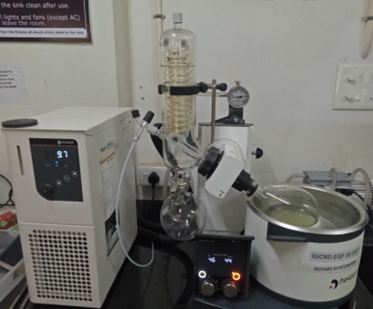
The Heidolph Hei-VAP rotary evaporator with G3 vertical glassware is a reliable and efficient system for solvent evaporation and concentration in research and industrial laboratories. The rotation speed is adjustable from 10 to 280 rpm, allowing for optimized evaporation conditions. The G3 vertical condenser provides a cooling surface area of approximately 1,400 cm², enabling high evaporation rates. The system supports both manual lift option with adjustable immersion depth and tilt angle. A digital display allows easy control of temperature and speed, and built-in safety features include overheat protection, standby mode, and residual heat warning.
Battery Testing System
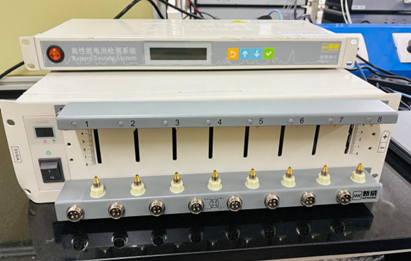
The Battery Testing System is a multi-channel electrochemical testing unit designed for evaluating the performance of battery cells, supercapacitors, and energy storage devices. This system supports up to 8 independent channels, allowing simultaneous testing of multiple cells under different conditions. Each channel features individual current and voltage control, enabling charge/discharge cycling, constant current (CC), constant voltage (CV), and constant power modes. The system offers high precision and stability, with real-time data acquisition and graphical monitoring of battery behavior such as voltage, current, capacity, and cycle life. Commonly used in battery R&D, material testing, and quality control, it supports a wide range of battery chemistries including Li-ion, NiMH, and LiFePO₄. The front-panel interface and software integration allow easy programming, data logging, and analysis, making it ideal for both academic and industrial battery research.
Centrifuge [CAM]
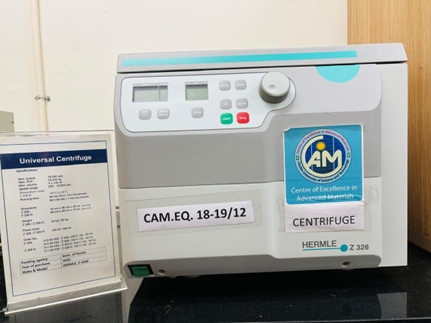
The Hermle Z326 Universal Centrifuge is a compact and versatile benchtop centrifuge suitable for a wide range of laboratory applications. It supports speeds from 200 to 18,000 rpm and generates up to 23,542 × g, accommodating various rotor types and tube sizes up to 145 mL. Key features include automatic rotor recognition, imbalance detection, programmable settings, and a user-friendly digital interface. The Z326-K model includes refrigeration with a temperature range of –20 °C to +40 °C for temperature-sensitive samples. With a quiet operation (<62 dB) and multiple rotor options, the Z326 offers reliable, high-performance centrifugation in a compact design.
Electrochemical Workstation
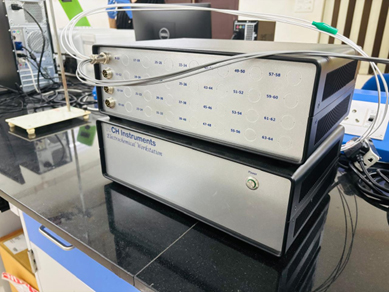
An electrochemical workstation is a versatile instrument used to study the electrical properties of chemical systems through techniques such as cyclic voltammetry, chronoamperometry, and electrochemical impedance spectroscopy. It typically consists of a potentiostat/galvanostat, a control interface, and specialized software for data acquisition and analysis. These workstations are essential tools in fields such as materials science, energy storage, corrosion studies, and sensor development, allowing precise control and measurement of current and potential in electrochemical cells. Their ability to simulate and monitor electrochemical reactions makes them invaluable for both fundamental research and practical applications. The potential control range is ±10 V and the current range is ±250 mA. The instrument is capable of measuring current down to tens of picoamperes. The steady state current of a 10 µm disk electrode can be readily measured without external adapters.
Electrospinning Units
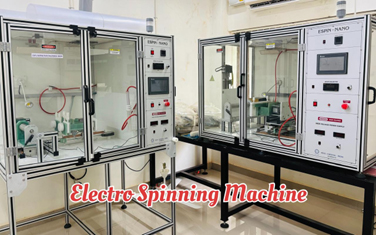
The ESPIN-NANO V1VC Electrospinning Machine is a compact and advanced unit designed for the fabrication of nanofibers through electrospinning. It features a high-voltage DC power supply capable of generating up to ±40 kV with a maximum current of 1 mA, providing precise and stable operation. The system includes a programmable syringe pump or peristaltic pump with adjustable flow rates ranging from 0.5 µL/min to 60 mL/min, ensuring consistent polymer delivery. The collector setup is customizable and supports various configurations, such as flat plate, rotating drum, and roll-to-roll collectors, with adjustable distances (typically 50–300 mm) from the spinneret. The V1VC model offers an enclosed spinning chamber with built-in LED lighting, digital temperature and humidity display, exhaust ventilation, and safety interlocks that disable the high voltage when the door is open. Optional features include a dehumidifier, coaxial nozzle setup, and environmental controls for enhanced reproducibility. This machine is ideal for research in biomedical engineering, filtration, textiles, and nanomaterials, providing accurate control over fiber morphology and process parameters.
Optical Microscope
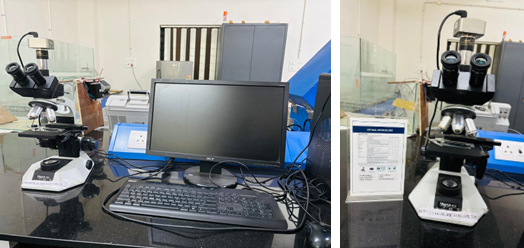
The Magnus MLX Plus is a robust optical microscope designed for educational, clinical, and research applications. It features semi-plan achromatic objectives (4×, 10×, 40×, 100× oil), wide-field 10× eyepieces, and a 45° inclined rotatable head for comfortable viewing. With magnification up to 1000×, it offers clear, sharp images supported by LED or halogen illumination. The microscope includes a coaxial mechanical stage, fine and coarse focusing, and an Abbe condenser with iris diaphragm for optimal light control. Its durable, anti-fungal coated optics and optional digital or phase contrast accessories make it highly versatile and reliable.
Probe Sonicator
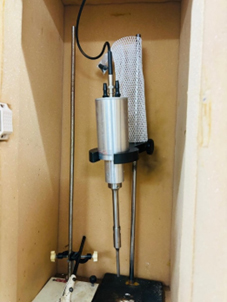
A probe sonicator is a high-intensity ultrasonic device used for efficient mixing, cell disruption, emulsification, and nanoparticle dispersion in laboratory settings. It operates by transmitting ultrasonic waves (typically 20–40 kHz) through a metal probe directly immersed in the sample, generating cavitation bubbles that collapse and produce intense shear forces. This results in effective homogenization and particle size reduction. Probe sonicators are commonly used in biological, chemical, pharmaceutical, and nanomaterial applications, such as DNA/RNA shearing, protein extraction, and formulation of stable emulsions. They offer precise control over parameters like amplitude, time, and pulse mode, making them suitable for both small- and medium-volume samples. Due to the heat generated during operation, cooling methods like ice baths are often used to protect sensitive materials.
Spin Coater
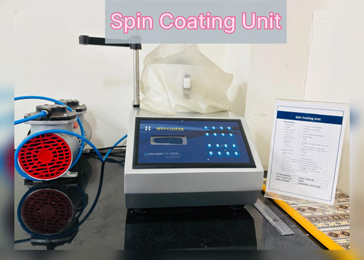
A spin coater is a laboratory device used to apply uniform thin films to flat substrates through a rapid spinning process. In this technique, a small amount of coating solution—such as a photoresist, polymer, or sol-gel—is dispensed onto the center of the substrate, which is then rotated at high speeds (typically 1000–8000 rpm). The centrifugal force spreads the liquid evenly across the surface, and solvent evaporation during spinning helps form a smooth, thin, and consistent film. Spin coaters are widely used in microfabrication, semiconductor processing, nanotechnology, and material science research for producing coatings with precise thickness control. Key parameters like spin speed, acceleration, and duration can be adjusted to achieve desired film properties.
Thermal Evaporation System

A thermal evaporator is a vacuum-based thin film deposition system used to coat substrates with metals or other materials through thermal evaporation. In this process, a source material (typically in wire, pellet, or granule form) is placed in a resistively heated boat, filament, or crucible inside a high-vacuum chamber. As the material is heated, it evaporates and travels upward to condense as a thin, uniform film on the substrate positioned above. Thermal evaporators are commonly used to deposit metals like aluminum, gold, or silver in microelectronics, optics, and nanotechnology applications. The system offers advantages such as high deposition rates, good film purity, and simple operation, making it ideal for research and prototyping.
Tribo Electric Measuring System
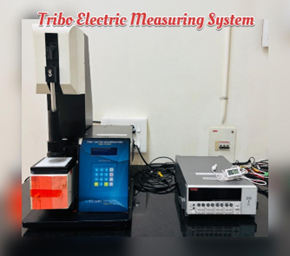
The Triboelectric Measuring System is a precision platform for evaluating charge generation on materials via controlled contact‑separation or rubbing motions, with charge captured using a Faraday cup or electrometer setup. It’s used to determine a material’s position in the triboelectric series and quantify static charge under repeatable experimental conditions. The enclosed design minimizes ambient interference, while motion parameters (speed, force, contact area) are precisely controlled. Typical configurations include inclined‑plane or slider mechanisms, test pellets (e.g., PTFE, quartz), sample holders, electrometers or charge meters, and associated measurement software. This system is widely used in material science, triboelectric nanogenerator research, and antistatic product evaluation.
UV- Visible Spectrophotometer [CAM]
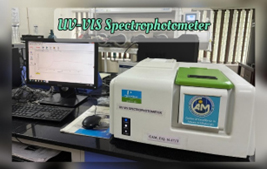
Make and Model: Perkin Elmer, LAMDA365
Funding Agency: Govt. of Kerala
Operating Range: 190-1100 nm with W-halogen and D2 interface
A UV-Visible spectrophotometer is an analytical instrument used to measure the absorbance or transmittance of a sample across the ultraviolet (UV) and visible light spectrum, typically from 190 to 1100 nm. It operates by passing light through a sample and detecting how much is absorbed at different wavelengths, allowing for qualitative and quantitative analysis of compounds. Commonly used in chemistry, biology, pharmaceuticals, and environmental science, UV-Vis spectrophotometers help determine concentration, monitor reaction kinetics, and analyze purity. They can be single or double beam, and often include features like variable bandwidth, digital interfaces, and software for data analysis.
Glove Box
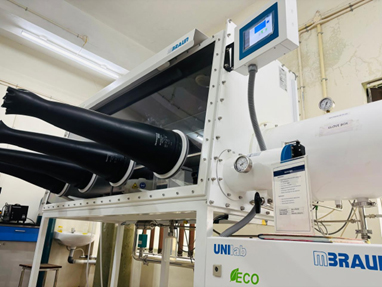
The MBRAUN China UNIlab Glove Box is a high-performance inert atmosphere workstation designed for handling air- and moisture-sensitive materials. It features a sealed stainless-steel chamber with large front-viewing windows and integrated gloves for safe and precise sample manipulation. The UNIlab system is equipped with a fully automated gas purification unit capable of maintaining ultra-low oxygen and moisture levels (<1 ppm) using high-efficiency molecular sieves and catalysts. The glove box operates under an inert gas environment (typically nitrogen or argon) and includes antechambers for secure transfer of materials without atmospheric contamination. Additional features include pressure regulation, PLC-based touch screen controls, and optional upgrades like vacuum pumps, solvent sensors, and cooling modules. Ideal for applications in battery research, OLED fabrication, materials chemistry, and semiconductor development, the MBRAUN UNIlab glove box offers stable, customizable, and contamination-free working conditions.
Microwave Synthesizer
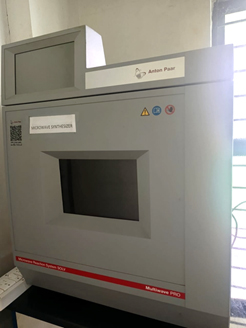
The Anton Paar Microwave Synthesizer is a high-performance laboratory reactor designed for rapid and efficient chemical synthesis using microwave energy. It allows precise control of reaction parameters such as temperature (up to ~300 °C) and pressure (up to ~80 bar), enabling faster reaction rates and higher yields compared to conventional heating methods. The system includes features such as sealed reaction vessels, temperature sensors, and programmable touchscreen controls for ease of operation. With scalable reaction volumes and optional autosamplers, it supports both small-scale synthesis and high-throughput applications. Commonly used in organic chemistry, pharmaceuticals, and materials science, the Anton Paar microwave synthesizer ensures safe, reproducible, and accelerated synthetic workflows.
Source Meter
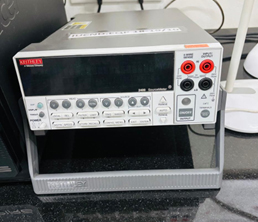
The Keithley Source Meter is a precision instrument that combines a power source and a measurement unit into a single compact device, ideal for current-voltage (I-V) characterization of electronic components and materials. It can accurately source and measure both voltage and current, covering a wide range from picoamps to amps and microvolts to hundreds of volts. Widely used in semiconductor testing, materials research, and photovoltaic studies, the Source Meter enables four-quadrant operation (source and sink in both voltage and current modes) with high resolution and low noise. With built-in scripting, USB/LAN/GPIB interfaces, and compatibility with LabVIEW and other automation tools, it offers fast, flexible, and highly accurate testing in both R&D and production environments